46 Days. My Longest Streak. Then Life Happened — and the App Reset Everything to Zero...
Dear Fellow Overthinker,
Forty-six days.
That's how long my best streak lasted. Forty-six days of meditation, exercise, journaling, reading, and water intake — tracked on a habit app that promised it would change my life.
On Day 47, a client's payment system went down. Thousands of pounds in ad spend running, broken links everywhere, pages 404-ing — every second it stayed broken, they were losing money. I spent the evening rebuilding their checkout flow instead of ticking boxes on a screen.
Five out of seven habits completed. Seventy-one per cent.
The app showed zero.
Not seventy-one. Not "good day, one short." Zero. Forty-six days — erased.
And despite knowing — intellectually, professionally — exactly why the system did that...
I still felt the knot in my stomach.
Let me back up.
My name is James Prosper. I run a performance marketing agency called Prospect Connect Media. Over the last decade I've managed over $8 million in ad spend building automated acquisition systems for prop firms, real estate companies, financial services providers. Conversion funnels. Retention architectures. Campaigns that run while their owners sleep.
Brilliant at building systems for other people's businesses.
Couldn't build one for my own life.
Not for lack of trying.
Habitica — the one that turns your habits into a role-playing game, because what every overwhelmed adult needs is a pixelated wizard avatar that dies when you forget to floss. Lasted 19 days.
Streaks — the app that literally has the word "streak" in its name. The exact mechanism researchers later proved causes measurable psychological harm. Lasted 23 days.
The "Don't Break the Chain" method, which the internet attributes to Jerry Seinfeld — except Seinfeld has publicly said he never used it. The whole story is fabricated. Lasted 34 days anyway.
A spreadsheet so elaborate it had conditional formatting and VLOOKUP formulas tracking my water intake. I once built a Zapier automation that sent me a Slack notification if I hadn't logged my habits by 9pm. It ran for eleven days before I muted the channel.
Each system worked for a while. Then life — actual, unavoidable life — intervened. A client emergency. A midnight server crash. A Tuesday where I simply didn't have it in me.
Every time, the system punished me. Not with cruelty. Worse: with indifference.
A silent reset. Forty-six became zero without acknowledging that forty-six days of showing up had ever happened.
The guilt. The shame spiral. The "I always do this."
Then I'd stop opening the app. Quietly. The way you stop texting someone back.
Within a month, the habits were gone too.
Sound familiar?
2am on a Bathroom Floor.
200 Research Papers.
Here's the part I don't tell people at dinner parties.
Thursday in March. I'd just broken another streak — Day 34 — and I was sitting on the bathroom floor at 2am while my family slept, reading Reddit threads about habit tracking. Not productively. Obsessively.
Looking for one person who'd figured out the thing I couldn't.
Found hundreds describing the exact same experience. Same guilt. Same shame spiral. Same quiet abandonment.
Something shifted. Not the inspirational kind. The angry kind. The kind where you realise you've been blaming yourself for a structural failure — like a pilot blaming himself for a crash caused by a design flaw in the aircraft.
I closed Reddit. Opened the research databases.
Didn't go to bed.
By 6am I was still on the bathroom floor with my laptop, reading a paper about dopamine receptors in rhesus monkeys. Coffee gone cold. Eyes wired. The kind of night where you forget to sleep because the anger is productive.
The Study That Should Be Printed on Every Habit App's Loading Screen
The first paper I found: Silverman and Barasch, Journal of Consumer Research.
Their finding should be printed on the loading screen of every habit app in existence:
People with broken streaks were less motivated to continue a behaviour than people who had never tracked a streak at all.
Slowly.
The tracking itself was counterproductive. The tool designed to help made things measurably worse than doing nothing.
I wasn't weak. Wasn't lazy. Wasn't "not disciplined enough."
I was using a system neurologically designed to destroy my motivation every time I needed it most.
Atomic Habits sold ten million copies. It's a brilliant book. But it doesn't address the fact that the tools people use to implement its advice are structurally designed to undermine it. Clear tells you what to build. Nobody was fixing the tools you build it with.
That night I stopped being a man who couldn't stick to habits and started being a man who was furious at the tools.
A 2001 Recording That Reframed the Entire Problem
I need to be honest about how this method actually came together, because it wasn't the story I'd planned.
Deep into my research spiral, I came across a course recorded by Dan Kennedy in 2001. Kennedy is a direct-response marketing legend — spent fifty years studying why people take action and why they don't. The course wasn't about habits. It was about offer architecture and behavioural triggers.
But something Kennedy said hit me sideways.
He was talking about systems design — how the structure of an offer determines the behaviour it produces. Not the content. Not the intention. The structure. Change the structure, change the behaviour.
I'd been thinking about habits as a motivation problem. Kennedy — from a recording made twenty-three years earlier — reframed it as an engineering problem.
The apps weren't failing because people lacked willpower. The reward architecture was wrong. The measurement system was wrong. The response to failure was wrong. The entire feedback loop was generating shame instead of progress.
And systems design was exactly what I'd spent a decade doing for clients.
I Was Just Fixing a Bug. Then I Found Wolfram Schultz.
I didn't want to write a habit book.
The world has enough. 4,000 on Amazon. Clear has his ten million copies. BJ Fogg has his Stanford lab. Who the hell was I?
By this point I'd already started building a tracker based on what I was learning —
a side project called EarnItGrid. Nothing fancy. Just a way to test the research on myself. Told myself I'd just ship an update. Fix the reward mechanism. Move on.
Then I found Wolfram Schultz.
Schultz is a neuroscientist at Cambridge who spent decades studying dopamine — not the pop-science version, the actual mechanism. His discovery of the dopamine prediction error changed everything.
Short version: your brain doesn't release dopamine when you get a reward. It releases dopamine when reality exceeds your prediction. And it withdraws dopamine when reality falls short.
Every streak counter exploits this backwards. The longer your streak, the higher your prediction. The higher your prediction, the more devastating the break.
Day 46 doesn't feel like a celebration. It feels like standing on a ledge.
I couldn't just fix a tracker. The problem wasn't UX. It was architecture.
The book became inevitable.
I Deleted 18 Months of Work. Three Times.
Version one was still a streak counter wearing a hat. Added "partial completions" and "rest days" but the underlying architecture was identical. Prettier labels on the same shame machine. Like putting a motivational quote on a parking ticket.
Failed at Day 23.
Version two rebuilt the reward mechanism around token economy research from Ayllon and Azrin. Better. But the measurement was still binary — pass or fail —
so the shame pathway stayed active.
Failed at Day 31.
Version three integrated Honest Tracking — the Four States framework — but recovery protocols were afterthoughts. Bolted on, not structural.
Failed at Day 38.
I threw all three out.
Eighteen months of work. Three prototypes. Deleted. The recycle bin on my laptop has never been so full or so emotionally significant.
And then I did something genuinely stupid.
I turned down $40,000 in client contracts over the next six months. Told my team I was stepping back from new business. Put Prospect Connect Media on pause.
To write a book.
My business partner thought I was having a breakdown. There were mornings I woke up wondering if he was right — if I'd just made the worst financial decision of my career to chase a problem nobody had asked me to solve.
But I couldn't un-see what the research showed. I couldn't go back to building systems for other people's businesses while knowing the system I was using for my own life was structurally designed to fail. That's the kind of knowledge that doesn't let you sleep.
The fourth version worked.
Not "sort of." Worked. Ninety days. Average completion rate: 84.2%. Three terrible weeks — two business emergencies, one week ill. Worst week: 71%. Recovered to 88% the following week. No reset. No shame. No starting over.
I wrote the book in the next three months.
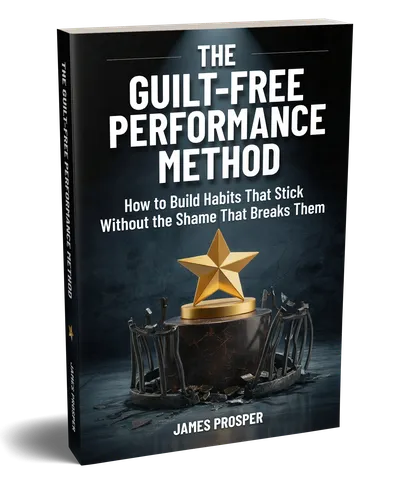
You're looking at it right now.